Choose toddler bedtime stories that offer a clear experience at a manageable pace. Interesting pictures, readable language and a satisfying ending matter more than a particular word count. A toddler can participate by listening, commenting, turning pages or returning to a favourite image.
This guide helps adults choose and share books. It does not prescribe a fixed bedtime duration or promise that a particular theme will make a child sleep. Age labels and reading estimates are useful starting information, but the child’s response should guide the actual reading.
Begin with the reader you have
A newly one-year-old and an almost four-year-old may want different things from the same book. Even within one age group, preferences vary. Some children want repeated phrases; others want to inspect vehicles, animals or familiar household scenes.
Our guides for 1-year-olds, 2-year-olds and 3-year-olds suggest different starting points without turning age into a developmental test. There is no requirement to abandon a simple favourite when a birthday arrives.
Inspect the whole book
Read several spreads aloud and look at the ending. Notice how many characters need introducing, whether the illustrations show the central action and whether the final page feels complete. A quiet cover can belong to an energetic story.
The guide to choosing toddler bedtime books provides a practical comparison. Consider the physical book too: size, binding and delicate features all affect how comfortably you can share it.
Choose a length you can enjoy
Short reading is a legitimate choice. Look for one narrative thread and avoid speeding through a longer story to meet the clock. Picture browsing and conversation can extend any printed reading-time estimate.
See short bedtime stories for toddlers for judging the actual demands. For brief attention to books, independent scenes and flexible stopping points may be especially convenient. Movement or an unfinished book does not by itself indicate a problem.
Use repetition without requiring performance
A refrain can invite participation, but the child should be free to listen. Repeated pictures and actions can also provide a recognisable pattern. Read the later pages of cumulative stories, which sometimes become much longer than their opening suggests.
The repetitive story guide explores these structures. If the child continually chooses one title, our guide to familiar-book preferences offers ways to retain the favourite while making room for another option.
Follow interests while checking tone
Animal stories can offer clear characters and enjoyable sounds. Everyday activity stories can turn folding, playing or finishing a task into a small narrative. Neither category automatically guarantees a gentle reading.
Inspect threatening images, chases and separation scenes before bedtime. The guide to stories without frightening scenes explains why the artwork needs checking alongside the words. Try unfamiliar stories earlier if you want to gauge the child’s response.
Share control of the physical book
A toddler may want to turn pages faster than you can read. Choose sturdy formats, offer a simple turn-taking rhythm and shorten what you read where the structure allows. You do not have to complete every sentence to share a meaningful picture.
See reading with enthusiastic page turners for handling skipped spreads and fragile books. If the arrangement becomes uncomfortable, change it or pause rather than repeatedly wrestling for the book.
Explore original books with accurate expectations
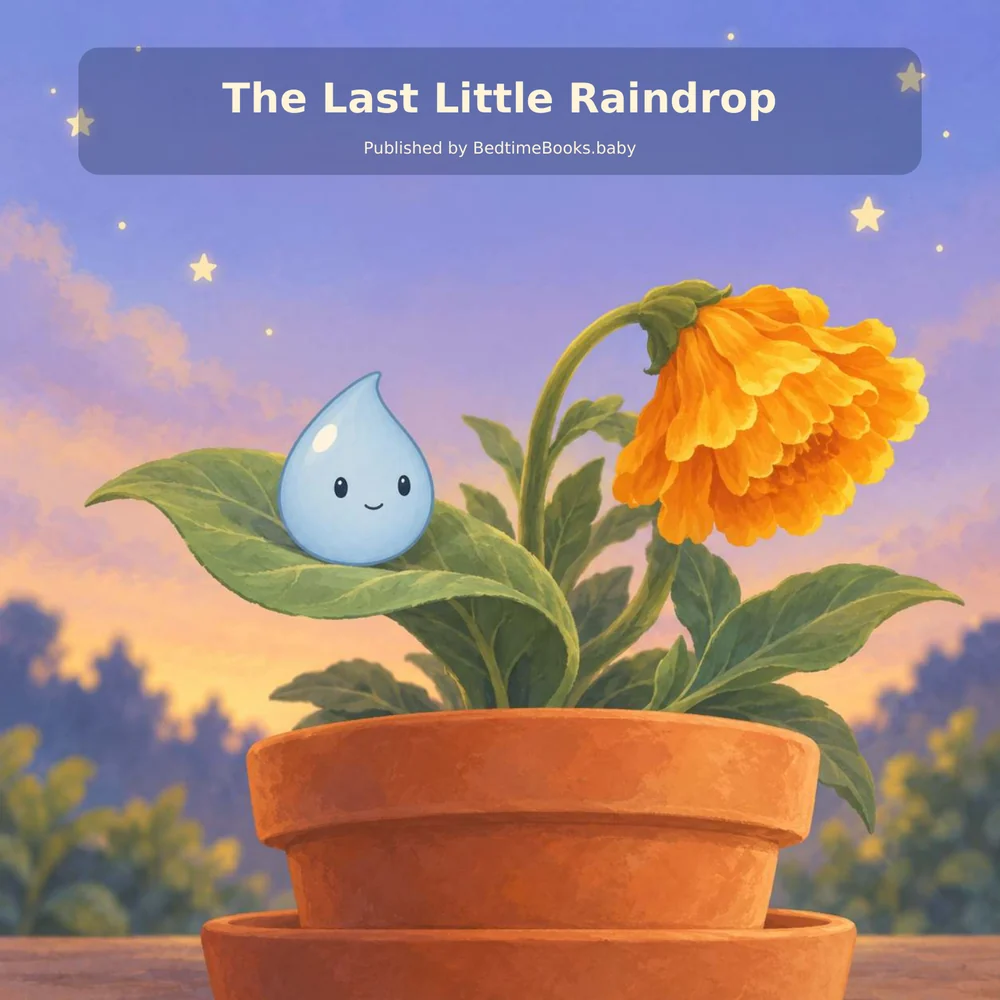
The Last Little Raindrop is listed for ages 2 to 3 and approximately four minutes; its description follows a raindrop through a quiet garden. Pip’s Morning Goodnight has the same age guidance and an approximate three-minute reading time, following a possum home at dawn.
View their previews and use the book pages for current availability. These are examples for comparison, not prescriptions for all toddlers. Our youngest catalogue guidance should not be extended automatically to 1-year-olds.
Keep a small shelf of suitable choices and let experience refine it. A new book can enter through daytime reading, a favourite can remain for many evenings, and a brief shared story can be enough when the day has been full.
Compare three possible evening choices
A book of familiar objects offers flexibility: you can enter at a favourite spread and stop without losing a plot. A short continuous story offers a complete beginning, middle and ending. A detailed search picture offers exploration, which may extend well beyond the printed words. Decide which experience fits the evening rather than treating all three as interchangeable short books.
You can keep more than one type available. A child may want an ordinary narrative tonight and close picture browsing tomorrow. No single format needs to become the permanent bedtime rule.
Before buying, read sample text at your usual pace. Include a page turn and a pause to look. This small trial reveals awkward phrasing and handling more reliably than an online description of the book as engaging.
Adapt when siblings share the reading
Children of different ages may attend to different parts of the same book. One might follow the plot while another names a picture or handles a separate sturdy volume. Position the shared book so everyone who wants a view can see it.
Agree a simple role, such as choosing the next book or turning one page, without requiring identical participation. If the story has fragile features, an adult can control that volume while offering a more robust book to handle.
A shared session does not have to satisfy every preference equally each evening. You can alternate whose choice comes first or read a brief separate favourite when the practical arrangement allows. Avoid turning the choice into a competition over which child is ready for the more advanced book.
Keep the relationship with books open
A difficult reading one evening does not establish that a child dislikes stories. Change the timing, format or expectation before drawing a broad conclusion. A book that invites energetic play may simply work better earlier.
Likewise, an enthusiastic long session need not become the new minimum. Keep a short option available and let some evenings be modest. Adults can set a clear limit kindly: one complete book, a chosen section or a small familiar passage.
BookTrust’s general reading tips offer further practical ideas for families. Use such resources as possibilities alongside your experience, rather than a script every household must reproduce. The useful next choice is one you can offer willingly and the child has room to enjoy.
Explore this topic in more detail
- Animal Bedtime Stories for Toddlers
- Bedtime Stories for 1-Year-Olds
- Bedtime Stories for 2-Year-Olds
- Bedtime Stories for 3-Year-Olds
- Bedtime Stories for Toddlers Who Prefer Familiar Books
- Gentle Bedtime Stories Without Frightening Scenes
- How to Choose Bedtime Books for Toddlers
- Picture Books for Toddlers with Short Attention Spans
- Reading with Toddlers Who Want to Turn Every Page
- Repetitive Bedtime Stories for Toddlers
- Short Bedtime Stories for Toddlers
- Toddler Bedtime Stories About Everyday Activities
Keep choosing separate from collecting
A useful toddler shelf does not need to be large. A few books that differ in structure can offer real variety: an independent picture sequence, a small continuous story and a refrain-led favourite. Add another when you can identify what different experience it offers. This keeps discovery connected with actual reading rather than the pressure to own every recommended title.
The shelf can grow gradually from those experiences, without requiring a new title every evening.