For a 3-year-old, look for bedtime stories with a clear central character, an understandable sequence and pictures worth revisiting. Some children enjoy a longer plot; others still prefer a few familiar spreads. The age label is a browsing aid, not a measure of attention or ability.
A well-chosen book gives the adult enough structure to read comfortably and the child enough interest to return. Novelty is optional.
Choose a manageable problem
A small story problem, such as deciding where something belongs or finishing an ordinary activity, can provide direction without prolonged suspense. Check how the problem resolves and whether the ending introduces another complication.
A gentle book can still include disappointment or uncertainty. What matters is how the story handles it and how your child responds, rather than whether every page is uniformly cheerful.
Make room for interpretation
A child may notice a detail the text does not mention. Pause to look, then continue. You can ask what they think a character is doing, but there is no need to quiz them on every event.
Use your own reading voice. Character voices are optional, particularly when an animated performance makes the evening more lively than you intended.
Offer a bounded choice
Two suitable books can provide a workable choice before reading begins. If your child wants a familiar title again, that is a legitimate selection. See toddlers who prefer familiar books for ways to offer variety without withdrawing favourites.
Read a new book yourself first. Its jacket description may not reveal a frightening illustration or a joke that needs explanation.
Consider an everyday story
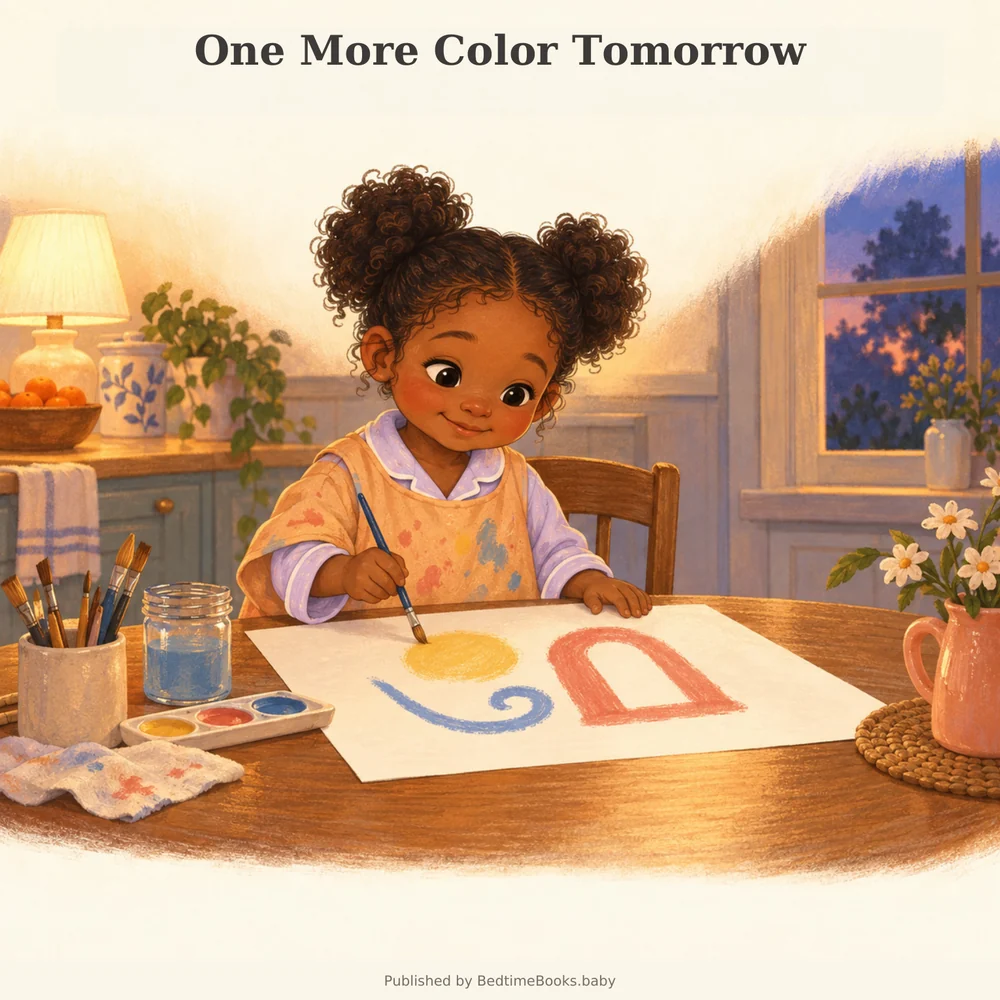
One More Color Tomorrow is listed for ages 3 to 4 and approximately five minutes. Its verified description concerns Nia, who has another colour in mind for her picture when bedtime arrives. The preview can help you assess whether its treatment of pausing an activity suits your child. Check the product page for availability.
Do not make the book a disguised instruction to stop playing. You can enjoy Nia’s story without requiring the child to copy her response. The toddler bedtime reading guide offers a wider framework for choosing stories around interests, format and the evening you actually have.
A choice before opening the book
Offer a familiar routine story and a more imaginative one, provided you are willing to read either. Describe them briefly through their actual content, not as the quiet choice and the exciting choice you hope the child avoids. Then honour the selection within the amount of reading you can offer.
If the child changes their mind immediately, you can allow one switch before beginning or keep the original agreement. Choose an arrangement you can explain simply. The aim is to make selection manageable, rather than negotiate indefinitely over a large pile.
After reading, notice whether the language and page handling worked for you too. The next choice can reflect that practical experience without making the child responsible for evaluating the session.
When the child asks why
A question may concern the character’s motive, a visual detail or something outside the story. Answer the part needed to continue, then see whether the child wants more. You do not have to open a long discussion every time a question appears.
If you are uncertain, say so plainly. A factual question about an animal or place can be checked later. Inventing an answer is unnecessary, and a picture book may not be intended as a reference source.
For imaginative events, you can distinguish what happens in this story from what happens in ordinary life without dismissing the fun of make-believe. A short explanation is often enough to return to the page.
When the ending is not the child’s preferred ending
A child may want another outcome or object to a character’s choice. You can acknowledge that interpretation without rewriting the book immediately. Ask what in the story led to the idea if the conversation is welcome.
The printed ending need not become a moral authority. Reading includes room for disagreement about characters and plots. If you invent an alternative together, keep it clear that this is your additional version. On another evening, the child may prefer hearing the original wording exactly as remembered. Both responses can coexist with enjoying the same book.