Ocean bedtime stories can focus on a shore, waves, a wide horizon or the experience of being near water. Unlike a guide to ocean-animal characters, this topic begins with place. Look at how the setting shapes the action and whether the scale feels comfortable for your reader.
Identify the viewpoint
Watching from a shore differs from travelling across open water or looking beneath it. Check whether the pictures establish where the character is. Clear visual orientation can make a changing scene easier to follow.
A large empty horizon may suggest wonder or isolation. The story should help you understand how the character experiences it.
Read patterns without assuming quiet
Repeated waves can provide visual or verbal rhythm, but an ocean story may also contain storms, separation or danger. Preview the whole plot. Blue colours and a sunset do not settle the question.
Read sound words in your own voice. You need not produce a large wave effect every time the sea appears.
Look for a distinct ending
A return, completed observation or change of light can provide closure. A continuing voyage may require a planned scene boundary if you are reading over several evenings.
Keep fictional events separate from real-water guidance. A picture-book adventure should not be treated as instructions for being near the sea.
Explore a shore example
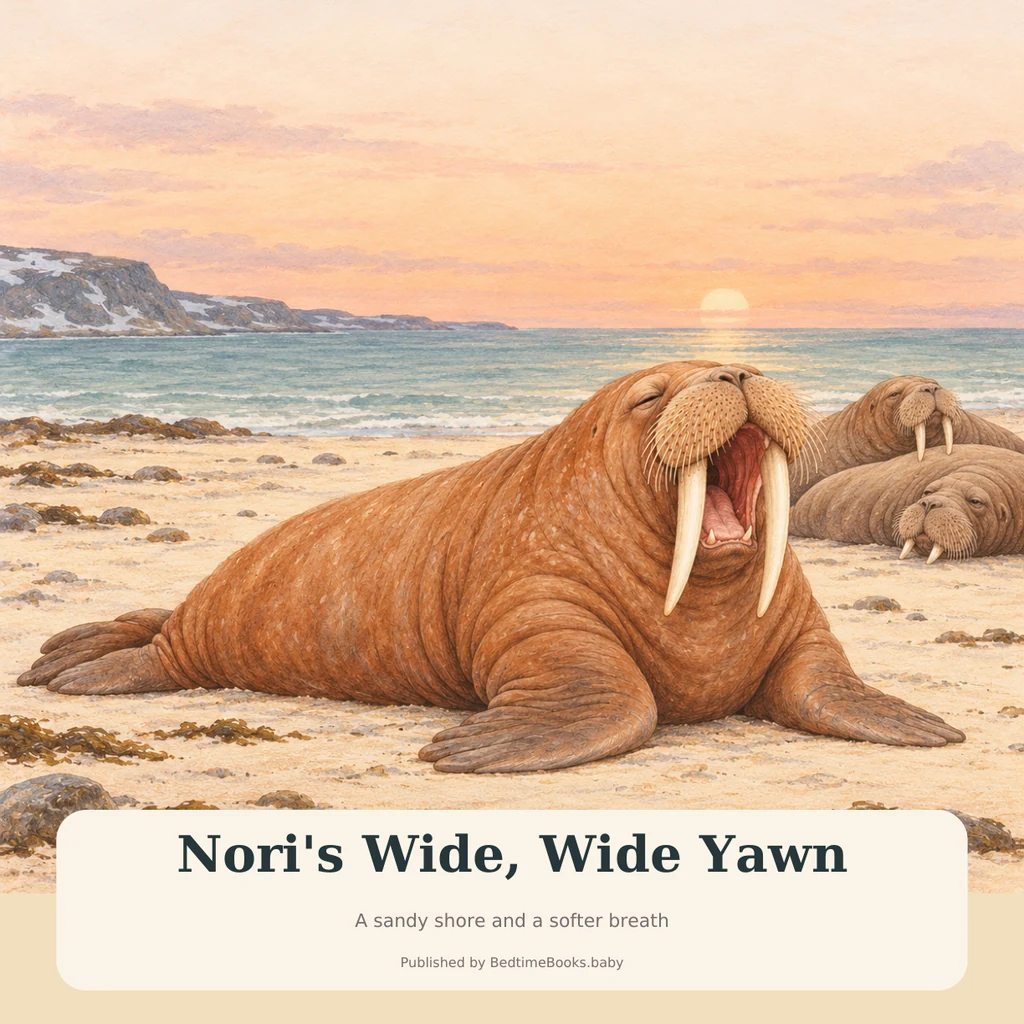
Nori’s Wide, Wide Yawn is described as Nori yawning on a broad sandy shore before settling beside two resting walruses. That supports a shore-setting example, not a claim about an underwater journey. Check the preview and recorded age guidance.
For creature-led narratives, see ocean animal stories. The nature bedtime story guide places oceans alongside forests, gardens and nighttime skies. Choose the actual viewpoint and plot you enjoy, using the book page for accurate availability and product details.
For another changing landscape, see winter stories, which may organise the pictures around seasonal light rather than waves.
Notice distance and return
A shore gives a character a stable place from which to watch change. A voyage moves the character away from that stability. Look at how the book makes distance readable and whether returning is part of its central question.
A final view of land can mean something different depending on the journey. Inspect the sequence rather than assuming the last sunset supplies a peaceful resolution.
Compare a wave pattern with a plot
Repeated waves may create a pleasing visual rhythm without much connected action. A plot may instead follow a character noticing, finding or completing something near the water. Decide which experience you want.
A descriptive book can be enjoyable for close browsing, while a connected story may fit a more continuous read-aloud. Neither form needs a claim about relaxation to justify it.
When a child asks about a real creature, current or place, keep uncertain details open for checking. A fictional ocean is not automatically a factual source. You can distinguish the invented event and return to the narrative.
Use previews to assess style and opening language, but a complete copy is better for screening later storms or separation. Recommend only what the actual book supports, with a clear distinction between shore setting and underwater animal focus.
Compare the reader’s position
| Position | Story opportunity | What to inspect |
|---|---|---|
| On the shore | Observation and repeated change | Whether the setting develops beyond scenery |
| On a journey | A route and a destination | Distance, transitions and emotional stakes |
| Below the surface | A different viewpoint and scale | Whether the focal action remains clear |
The last position may overlap with an animal-led story, but the book’s actual centre still matters. Read who or what organises the pages. A quiet-looking sea can contain an urgent plot, and a modest shore event can provide a complete narrative. Do not rely on colour or a sunset alone. Leave time to see how the pictures connect, and use the product’s real description when recommending it. An ocean setting offers possibilities rather than a guaranteed bedtime effect.